Showing posts with label writing. Show all posts

Tuesday, 8 December 2015

The Adventures of Huckleberry Finn

Mark Twain’s, The Adventures of Huckleberry Finn, looks at the racial and moral world through the eyes of the protagonist Huck, exploring the relationship between Huck and Jim and their journey to freedom along the Mississippi River. T. S. Eliot opens his 'Critical Essay' on Mark Twain's The Adventures of Huckleberry Finn by declaring that it 'is the only one of Mark Twain's various books which can be called a masterpiece'.

T. S. Eliot marks ‘the Boy and the River’ as the most significant features of Huckleberry Finn within his essay, ‘An Introduction to Huckleberry Finn’. He states that these two elements, which when treated with ‘sensibility and his [Twain’s] experience formed a great book.’ The boy is used to narrate the story, with the unfolding events presented through his eyes, and by doing so Twain does not force Huck’s thoughts and opinions onto the reader, Huck simply observes the world and accepts the world for what it is and what it inflicts. The River holds great significance over the novel and has the power to control the journey of Huck and Jim. The River has the power to deter Jim from his freedom in Cairo and to separate Huck and Jim before reuniting them later in the novel. The River signifies the power of nature and the weakness of man. 

Mark Twain: 30th November 1835 - 21st April 1910

Eliot discusses how ‘It is Huck, who gives the book style’ by presenting the book through Huck’s eyes. Twain creates a narrative that discusses the events with a natural, boyish flow that comes only with a character that is aware, reflective and true to themselves. Without the placement of Huck as the narrator and main character the story would be a great deal less effective and the underlying themes of the novel would be lost. Eliot characterises the role of the boy, Huck, in the adventure, as the boy that Mark Twain still was, unlike Tom Sawyer who was the boy that Mark Twain had been. (Eliot, Introduction p. 329) Eliot describes Huck as being an ‘impassive observer’ who ‘does not interfere, and […] does not judge.’ (Eliot, Introduction p. 330) This makes for a change in narrative as previously the narrator had some sway within the text.

The relationship that exists between Jim and Huck is a key theme throughout the novel as both characters are victims of an unjust society and relate to one another as outsiders. The relationship between the two is viewed by Eliot as one of co-dependency. Eliot states that ‘Huck in fact would be incomplete without Jim […] they are equal in dignity.’ (Eliot, Introduction p. 331) Huck is not allowed to act as a boy would and find joy within his practical joke on Jim but has to bear the responsibility of a man. At a time when Jim would be considered less than an animal, this shows the intensity of the relationship between Jim and Huck. Huck presents a more evolved child character as he is more aware of the world around him, allowing for a more grown up perspective of the real world, a world which Jim has experienced and been personally victimised by. This creates a deeper understanding between the two companions and highlights the problematic society of the time. 

The Adventures of Huckleberry Finn
Mark Twain
The significance of the landscape through which these figures journey is that the River actually manipulates and controls every situation. It is the River that decides where Huck and Jim shall go and it is the River that leads Huck on his adventure. Additionally, as Eliot states, Huck is ‘also the spirit of the River.’ (Eliot, Introduction p. 333) He seems to have no beginning or end, and he, like the River is experienced by the reader than just viewed or acquainted with. ‘It is Huck who gives the book style. The River gives the book its form.’ Elliot makes it clear that there is an obvious connection between the River and the landscape, with the River being a strong influence over the progression of Huck’s and Jim’s journey. The natural influences determine where the companions end up as it can often be unpredictable and unruly. ‘The River is never wholly chartable: it changes pace, it shifts its channel, unaccountably; it may suddenly efface a sandbar and throw up another bar where before was navigable water.’ The River is the determiner of their success and strays them on a course unknown.

With modern readings focusing solely on the issues of race and slavery within this novel, it is easy to dismiss the importance of the other aspects such as close relationship with Jim and Huck, where the former acts as a paternal figure to the latter. Issues of race are closely intertwined with the relationship between the pair however this soon progresses into something more, something held closely to humanity rather than a difference in appearance. Additionally, the importance of the River may also be lost on the reader, if the sole focus is placed upon race, however with close reading and analysis it is clear how all of these aspects link with one another in order to combine the tropes of The Adventures of Huckleberry Finn.

Yours adventurously,
Sadia Parveen.
@Sadia_x95


     www.underthefable.com


Thursday, 12 November 2015

The Relationship between Practical Criticism and New Criticism

New Criticism is the development of the Practical Criticism approach by American critics and poets. R. C. Murfin, R. C and S. M. Ray describe what New Criticism is within The Bedford Glossary of Critical and Literary Terms. ‘The foundations of the New Criticism were laid in books and essays written during the 1920s and 1930s by I. A. Richards (Practical Criticism [1929]), William Empson (Seven Types of Ambiguity [1930]), and T. S. Eliot ("The Function of Criticism" [1933]).’ New Criticism regards literature as an independent item. Murfin and Ray continue to state that: ‘rather than basing their interpretations of a text on the reader’s response, the author’s stated intentions, or parallels between the text and historical contexts, New Critics perform a close reading, concentrating on the relationships within the text that give it its own distinctive character or form.’ Although we associate New Criticism with certain principles and terms—such as affective fallacy (the notion that the reader’s response is relevant to the meaning of a work) and intentional fallacy (the notion that the author’s intention determines the work’s meaning)—the New Critics were trying to make a cultural statement rather than to establish a critical dogma.
Practical Criticism is a form of close reading and is related to developing the skill of being able to critically analyse texts (usually poetry) on early readings. It originated with Richards and it is the way that one can come up with analytical and interesting points about a piece on first reading, rather than getting into the academic exercise of theoretical criticism. The main ideology behind Practical Criticism is rather than concentrating on the author or the social context, you focus purely on the text itself and the lexis itself. According to Peter Barry’s Beginning theory: An Introduction to Literary and Cutural Theory, ‘the job of criticism is to interpret the text, to mediate between it and the reader.’ Practical Criticism perceives literature as a vehicle for transmitting universal truths and eternal values, considering that the meaning of a text remains constant throughout time, and is there to be extracted from the text.

Richards gave students poems in which information about the author and date were left out on purpose. He went on to analyse the student opinions. He reported the results in Practical Criticism: a Study of Literary Judgment, (1929). What was apparent throughout was many fluent and avid readers failed to understand what the poems were about.
When asked to write about Spring Quiet by Christina Rossetti, (although they did not know who wrote it or when) two students responded;

“It has little merit - parts of it are deplorable. The first two verses are quite attractive, and the rhyme ‘thrush’ with ‘bush’ is almost bearable. When ‘boughs’ and ‘house’ come next however, the attempt to enjoy the poem fails. There are not only poor rhymes, there is also much poverty of thought and much real silliness in the poem.”

And “The first 2 lines are not sense. I laughed at the rhyming of thrush and bush; and boughs and house. Reminds one quite pleasantly of the ‘poetry’ one wrote when aged ten.” (Richards, Practical Criticism: a Study of Literary Judgment)

Richards commentates that, ‘reminders of our own poetic efforts, not only at the age of ten but even in years closer at hand, have an inevitable influence on our judgment, a useful influence when it keeps within its province, but dangerous when it meddles with matters beyond it. All but a very few beginners in verse find rhyming a great strain upon their verbal ingenuity and attention.’ (Richards, Practical, p. 33)

Intentional fallacy and affective fallacy are two terms introduced by Wimsatt and Beardsley to juxtapose popular beliefs such as to know what the author intended with the text is to fully comprehend the text itself and judging a poem erroneously, based on the emotional response of the reader. Delahoyde states within New Criticism: Introduction to Literature that ‘the "intentional fallacy" is when one confuses the meaning of a work with the author's purported intention (expressed in letters, diaries, interviews, for example).’ Therefore showing that New Critics believe that the work isn’t related to the author as such and is completely unconnected. ‘The "affective fallacy" is the erroneous practice of interpreting texts according to the psychological or emotional responses of readers, confusing the text with its results.’ New Critics believe that the text is a stand-alone piece, and should be treated as such. In continuation, Murfin and Ray state within their glossary of critical and literary terms that ‘New Criticism regards poems as having elaborately structured, complex meanings with a relative disregard for their historical context.’ In this regard, New Criticism is similar to Practical Criticism as the latter also focused on the text rather than any background to the poem or on the author. However, New Criticism stresses greatly on close textual analysis, especially on literary devices such as the use of sound effects like onomatopoeia, images/symbols like metaphors and similes, rhythm, irony and repetition.

Thus it is safe to state that Practical Criticism and New Criticism go side by side, with New Criticism furthering the ideologies behind Practical Criticism. Richards and Empson can be seen as the founders, with T.S Eliot furthering the ideas in more detail. In a sense, they’re both the same theory with how the texts are perceived, however New Criticism goes a step further with its underlying beliefs. New Critics place great emphasis on the fact that the meaning of a text is intrinsic. In essence however, New Criticism is Practical Criticism, just with more depth.

So, with this in mind, do you think you’ll be engaging with texts in this regard? Or perhaps you already did and didn’t know it! Let us know in the comments below.

Yours Practically,

Sadia Parveen.

@Sadia_x95


Sunday, 18 October 2015

My Writing Process


This week I thought I'd do something a little different. Many of you may be writers yourselves, or you may just be curious of a writers process. Well, this week, I'll be giving you a bit of an insight into mine!
WRITING SPACE:

I don’t exactly have a particular space I only go to write. My writing space is basically my space for just about everything, but just look at it:


This is the single, most comfortable armchair I’ve ever sat in, in my entire life. It is just brilliant and so cosy. I just sit back and relax while I go about my writing. This is probably one of the most important things when it comes to writing. Finding that spot you’re most comfortable in.
Some people need a room to themselves where they’re away from any distractions or noise, which, if you live with others or still with your parents, is most likely going to be your bedroom.
For me however, I’ve become so accustomed to the TV noise and my parents talking that it barely affects me anymore. I feel most comfortable and ready to write when I’m sitting in my armchair in my living room. The room can be full of noise or completely silent and I’ll be able to get the job done.
The problem occurs when my parents are watching something I’m interested in, this is where I get hugely distracted and end up spending an hour and a half watching the TV without realising. In this case, I usually put my headphones on and blast some music. This sends me right back into writing mode and I completely forget about the world around me.
Technically there is another place I write quite frequently. And if you don’t mind finding out a little too much about me I’ll tell you.
The bath. Yes, the bath.
I don’t know what it is about being in the bath that makes me suddenly so inspired to write but for some reason it does and you know what, I just go with it, because any time inspiration hits you, you should milk it for all it’s worth. It doesn’t come along very often.

NOTES:

Are you like me? Do you have five thousand word documents open at once while you write?

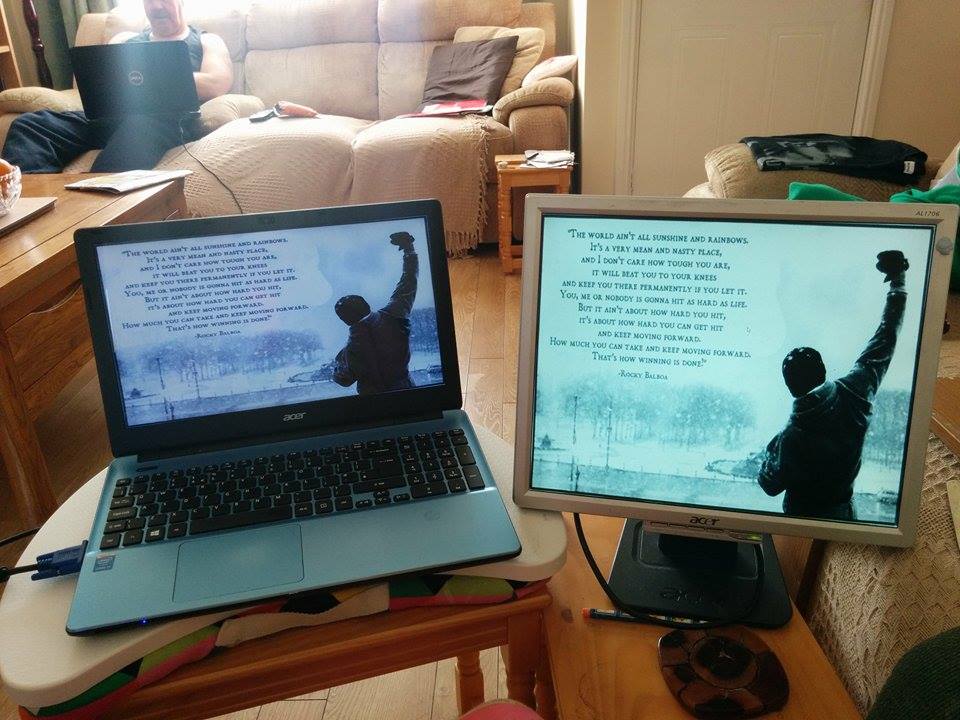
One thing I’ve been doing recently is hooking my monitor up to my laptop (and yes that’s Rocky wallpaper – I’ll get to that in a minute). I move all my notes onto the monitor screen so I can see everything at once without flicking through document after document to find the bit of information I need.

It is a good idea to have a system like this. Even if you just have something that you put sticky notes on (shout out to my friend Jess). It will make your life a hundred times easier while writing.

IDEAS THAT OCCUR WHEN I’M NOWHERE NEAR MY LAPTOP:

This used to present a problem for me, because I never had a decent enough phone to write and store things. At first I used to write my ideas in a text message and save it to my draft folder. Then I’d later write it up on my laptop.
Problem: By the time I was anywhere near my laptop, I’d completely forget I ever had an idea, and therefore my phone would collect around 30 draft text messages before I realised and would have to type them all up one by one.
These days though, I have a much better phone, which allows me to write a document and save it directly to the folder I want it in on Dropbox as a word document. There’s no messing about, no writing things up later, it is simple and so quick to do.

FUEL:
Most people generally go down the coffee or energy drink or alcohol route when they spend extensive amounts of time writing.
Me? I’m a little different. Tea is my fix.
Tea is a necessity. Tea is life. I cannot physically or mentally function without a cup of tea and this is why I constantly have a giant mug beside me while I write. This does usually mean a break every ten minutes to make a new cup, but it’s good to have breaks.
Whatever your fix is, make sure you have it on hand when writing. It will make your life incredibly easier.
P.s. Just don’t go down the Coleridge route. Opium (more commonly known as heroin) is going a little too far.

INSPIRATION:
On those days where nothing is going your way, or you feel like giving up writing altogether, I like to remind myself of my favourite quote to help me keep going.


This picture (as you saw earlier) is my desktop wallpaper, so it’s always there to remind me push through whatever writers block or troubles or worries I have at the time. I’m seriously considering getting this tattooed on my arm.
It’s always good to have a pick-me-up close by when you’re feeling down in the dumps. Every time I read this quote I immediately feel better and strive to push through the hard times.
I hope you enjoyed this post. As I said, it is a little different from what I've posted in the past. If you would like more posts like this, then don't hesitate to let me know.


Yours weekly,
Jennie Byrne
@mustbejlb (on Instagram and Twitter)


Please comment below, all feedback and suggestions are welcome.

Sunday, 4 October 2015

Writing That Killer First Line


There is nothing better than coming up with a new story idea and writing that brilliant first line to draw your audience in. Let’s look at a few examples:

“I’m pretty much fucked.”   
      -  The Martian by Andy Weir 


“I was born twice: first, as a baby girl, on a remarkably smogless Detroit day in January of 1960; and then again, as a teenage boy, in an emergency room near Petoskey, Michigan, in August of 1974.”
- Middlesex by Jeffrey Eugenides


Both of these first lines immediately draw in the audience. We want to know why the narrator is fucked! We want to know how the hell somebody can be born twice and know about it!

There is nothing worse than opening a book to the first page and seeing: “My name’s Emma Brooks, I’m 19 years old, I live in London with my mum and dad.” That really just makes me want to blow my brains out. Of course, details like this are important to finding out information about our protagonist, but the way we find these things out should be through something like speech, usually iterated by another character. “Emma…we’re moving.” See, it moves the plot along while also informing the reader the name of our protagonist.

But, we’re getting off course now.  

That first line is important. It can be the difference between somebody giving your novel a chance, or putting it back on the shelf because it doesn’t grab their attention. The more generic the first line, the harder it will be to prove yourself to your readers. I can’t tell you the amount of times I’ve read a novel where the first incident that grabbed my attention happened on page 115.

Be careful. There’s always the risk your first line will set up too much expectation for the rest of the story and you face the problem of ensuring the story meets those high expectations.

That killer first line usually pops into your head once in a blue moon, no matter how complex or simple, it usually happens when least expected. Typically during a time you can’t write it down!

I’ve learnt that instead of obsessing over the first line, I just simply start the story. I start at the beginning and write till the end. Then I go back. By now I know the story inside out, I know the characters really well and the world I’ve created. Usually it’s much easier to edit that first line and come up with something that will really grab the reader’s attention. So just tell your story. The right first line will come to you eventually.

For my dissertation module this year I have currently written 1,500 words of it and I love my first line. My tutor loves my first line, and I deem this an epic start to a story and it reads as follows: ‘Ask anyone to describe Kyle Davies in one word, they’d all say the same thing. Cunt.’

This is a little exclusive for you. Congratulations. I’m sure it’s made your day.

I think immediately this will shock people. I hope it’s shocked you. Shocking people usually makes them interested to read a little more…and then a little more. I believe I have the definition of a killer first line, and if you tell me wrong, I will ignore you. Just kidding…
 

Yours weekly,

Jennie Byrne

@mustbejlb (on Instagram and Twitter)


Share your thoughts below. All comments and suggestions are welcome.

Friday, 25 September 2015

The Hidden Chorus

The chorus. Where did it come from? Why is it so important? Why have so many writers included it within their work such as Shakespeare? Well, let’s take a trip back to 776-336 BC.

In Ancient Greece, the chorus was a very important part of Greek tragedies, if not the most important part. Daniels and Scully, authors of “What is really going on in Sophocles' Theban Plays”, state, "No feature of Greek tragedy is more intractable than the chorus." For Ancient Greeks, the chorus' role was an obvious one and although the language was always in a formal dialect, it wasn't difficult to understand the chorus' message. Tragedies were written in verse, and actors would either say or sing their lines. Only men could perform in the plays, females performing was unthinkable. In Ancient Greece, the playwright was a choreographer and a composer in addition to being a playwright. He choreographed the dances for the chorus as well as composing the music that the chorus sang. The chorus usually sang and danced between lines, and the role of the chorus, in this regard, could be seen as a form of entertainment and the audience would have been highly interested upon watching this.

Aristotle argued in “Poetics” that “…the chorus should be regarded as one of the actors; it should be a part of the whole and should participate in the drama not as in Euripides but as in Sophocles.” From this we can gather that Aristotle values the chorus greatly as part of a play and believes that Sophocles was superior in his choral writing. Choral odes should not be “mere interludes,” but should contribute to the unity of the plot – which according to Aristotle was the most important element in a tragedy. The masks that were worn during the performances were generic for the chorus, and this was to highlight the chorus as a whole rather than individuals. This reinforced the viewpoint of how the audience of the time would view the chorus as a whole body, rather than individuals and the viewpoints of the chorus was relatable to the viewpoints that the community held as a whole, not just individual beings.

Like most of the ancient Greek tragedians, Sophocles divides his choral odes into strophic pairs – strophe and antistrophe. Both sections have the same number of lines and metrical pattern generally. In Greek, ‘strophe’ means ‘turn,’ and ‘antistrophe’ means ‘turn back/against.’ During the strophe, choruses danced from right to left and during the antistrophe they did the opposite. Sophocles may have split the chorus into two groups, so that it was as if one part was conversing with the other. The oppositions created by strophe and antistrophe may represent the endless, irresolvable debates which were prevalent in Ancient Greek society.

An example of the chorus’ integral role within a Greek play, ‘Oedipus Rex’ serves a fitting illustration. The first time we hear from the chorus in ‘Oedipus Rex’ is directly after Creon, Oedipus’ brother-in-law returns from the God Apollo, with Apollo's message about how to save the city of Thebes from plague and ruin. The strophic pairs are generally in more extravagant and ambiguous verse than the actors' lines are. The strophe is reacting to the news from Apollo and in some ways foreshadowing the events to come when it says, "I am stretched on the rack of doubt," and then words are used that express fear and foreboding, like "terror and trembling" and "full of fears" and "doom." The language is rich with metaphors, and for Aristotle, “it [metaphor] is the mark of genius, for to make good metaphors implies an eye for resemblance.” The antistrophe is calling on the Gods to help them, such as ‘Athene’, ‘Artemis’ and ‘Phoebus’, thus reflecting the polytheistic beliefs held by the Ancient Greeks. The function of the chorus here is split into two. The first function is to show a reaction to the news that they have just received and the second is to plead to the Gods, thus showing the integration of the chorus into the play. G. M. Kirkwood states in his journal “Phoenix”, titled ‘The Dramatic Role of the Chorus in Sophocles’ that “It is generally assumed that the main function of the Sophoclean Chorus is a philosophical one; that it serves above all as the spokesman for a certain view of life.” The chorus were seen as the voice of the community and perhaps due to this, those that were performing as part of the chorus were local men and it was seen as their duty.

Unlike his contemporary Euripides, Sophocles was known to mix his chorus into the action of the play. In ‘Oedipus Rex’ we see the chorus advising Oedipus to remain calm, such as when they tell Oedipus and Creon to stop arguing, “My lords, an end to this.” There is direct address between the chorus and Oedipus which shows that the chorus were not just overseers but involved in the plot too. After Oedipus pieces things together and realises what he’s done and sees the truth, ‘anagnorisis’, the chorus mourns the tragedy.

Alternatively, the chorus in ‘Oedipus Rex’ manages to convince Oedipus not to banish or execute Creon at the start. Although the chorus only speaks once in a while, it is present throughout the play as an observer. This is rather significant as they oversee all of the action and help make decisions, such as when Oedipus asks the chorus to help send him out of Thebes or kill him and the chorus leader replies that Oedipus should go “To a fearful place from which men turn away, a place they hate to look upon.” This shows the significance of the chorus, not just as narrators of the action, but as an integral core to the play.

Therefore, the chorus especially within Greek tragedies has a variety of roles and functions. The chorus comments on the play's action and foreshadows future events. As well as this, the chorus help characters of a play and therefore are connected directly within the play. The chorus also give an in depth view of the character’s emotions and thoughts as they explain Oedipus’ feelings, “Unhappy in your fate and in your mind which now knows all.” Sophocles also used the chorus to comment on the larger impact of the characters' actions and to illustrate a play's central themes. Shakespeare’s use of the chorus in a similar manner can be seen to have drawn from the Ancient Greeks.

Yours dramatically,
Sadia Parveen.


@Sadia_x95


Have something to say? Please comment below, all feedback is welcome.

Sunday, 13 September 2015

A brief history of nonsense - Flarf poetry


 As a self confessed lover of all things pretentious I have a soft spot for Flarf poetry. Chances are you do not. Flarf poetry is as unloved as it is unknown, lost in the fog of the internet (ironically so vital in its creation) and the sheer volume of poets and poetry coming out of the wires nowadays. Those who have heard of it, or even read some of it, almost universally hate it.

 To be fair, it is easy to see why. But before we castigate it and push it to one side as nonsense for nonsense sake, we should have a look at where it came from.

Flarf was born in New York at the turn of the century, and its creation can be attributed to one man. Gary Sullivan created a nonsense poem to send into a scam poetry competition (no names here, we all know who they are!) and Flarf was born. The poem, the first lines of which are shown below, is meaningless and has no context or poetical merit, but was of course included in the poetry competitions winners;

Yeah mm-hmm, it's true
big birds make
big doo! i got fire inside
my huppa chimp (tm)

Gary sent this masterpiece off to his friends, and pretty soon they were all involved in sending poems around the group. Flarf became a serious poetic consideration soon after, with people taking Google-search snippets and forming them into humorous/disturbing verses. This took Flarf from nonsense to something more, injecting it with a dash of pop/meta culture and meaning it started to mean.

You can read a lot more in-depth history on Flarf if you so wish, but to me that is missing the point. Flarf wouldn’t want you too. Flarf is only concerned with the now, the hyper-real and the nonsensical. In its brief history, it has grown only in one area. Now a few of the poems are good, whereas once they were uniformly awful.

If you love your hog of a oneself
grinding up against a dirty guitar
kung fu-style
in negative space
then you are cocked up with lollipops,
doggie style.
Expect toy ATM's next.

The lines above are taken from Sharon Mesmer’s ‘I am cocked up from overpower’. This is a great example of Flarf starting to mean something rather than just be something. The poem is satirising the very culture and saturation it was born from, a key element of Flarf. Flarfist’s know how ridiculous the fact their poetry is seen as art is and have integrated that in to their poems.

awe yea I open a photo album I found under my bed 
uhhuh, The dusty, leather cover decaying and smelling of the years 

awe yea baby Regrets mingling with my tears 

The above is an exerpt from Drew Gardner’s ‘As Dolphins Langour’. Using the same technique as other Flarfist’s, Drew has constructed something with actual emotional heft. Not easy to do, in fact I would argue it is the more difficult task. Flarf poets limit their palettes (maybe I should write poetry with lines like that) and therefore making something worthwhile becomes more difficult.

The writing of Flarf poetry is not solely down to Google searches. Another popular method is to take a phrase and run it through translators until it takes on other meanings entirely. This juxtaposition allows for some interesting creations but also can have a subtext. What happens, for example, when we run ‘I shatter into a thousand porcelain shards’ through translate a few times, we get ‘I own a piece of cloth decomposition’ as highlighted in the fantastic (and free) E-Book ‘Ten poems ruthlessly mangled by Google Translate’ by Ari Eckols.

But is Flarf something that requires anyone’s interest, or is it just tripe for tripe’s sake. Does it have any meaning? Does it have any place in serious literary circles?

Yes. Yes it does. Flarf is the trip-hop of poetry. It’s the pop-art of the Meta-age. Taking samples and pasting them together to become more relevant is practiced in all art forms. Forming something beautiful from otherwise unrelated snippets. Flarf is this generation’s Beat poetry. When Kerouac wrote How to Meditate, I am sure people reacted in the same way as they do when they read Flarf.

the gland inside of my brain discharging
the good glad fluid (Holy Fluid) as
i hap-down and hold all my body parts
down to a deadstop trance-Healing
all my sicknesses-erasing all-not
even the shred of a 'I-hope-you' or a
Loony Balloon left in it, but the mind

Not that different is it? Just as beat poetry was taken in and adored by those ‘hyper-intellectual’ enough to instruct the rest of us in what to enjoy, so Flarf was/should and will be heralded as a harbinger of cultural nirvana.

But what do you guys think? Is Flarf purely an attempt to cash in on meta-culture and not real poetry? Or, like me, do you love Flarf with all your heart!

Yours Nonsensically

Stuart Buck


@stuartmbuck